What Your Insurance Company Should Know


When you’re filling out a homeowners insurance policy application, you’ll probably run across a few questions that might make you wonder, “Why does the insurance company need to know this information?” Some of the questions might even seem unimportant to you, but can significantly affect the premium your Florida homeowner’s insurance company charges you – or determine whether the company is able to insure you at all:
A roof is a roof, right? Although they all offer protection from the elements, different roof shapes are not created equal. Florida homes tend to be one of three roof types, hip, gable, and flat, and they all perform differently in a storm:
Hip roofs are more complicated and labor-intensive to build, but are also more wind-resistant in a storm. They slope on all four sides to form a pyramid shape, allowing wind to more easily pass over the roof and reducing the chance of roof damage. Most Florida homeowners insurance companies offer a discount for homes with hip roofs.
Gable roofs are easier and less expensive to build and are the most common type of roof found on Florida homes. They have a triangular-shaped “gable end” which is prone to collapse in hurricane-force winds if not properly braced.
Flat roofs are most commonly associated with commercial structures, but can be found on residential properties, too. Flat roofs take a pounding from harsh weather, and rainwater tends to pool on those structures, so they rarely last as long as a sloped roof.
Although you consider your beloved Fido to be part of the family, insurance companies have to consider the risks associated with pet ownership. Nearly five million people are bitten by dogs each year, and almost one million of those cases result in medical treatment. If your dog bites or even knocks over a visiting friend or relative, dog liability will help pay medical and lawsuit-related expenses. However, there are breed limitations and restrictions, so check with your insurance agent to see if your four-legged pal is covered.
Even if the nearest fire station is less than a mile away from your home, many homeowner’s insurance companies will ask about the proximity of your home to a fire hydrant. Living within 1,000 feet of a fire hydrant is a major benefit in case of a fire and will generally help lower your premium.
This question refers to the construction of your house. Masonry homes are made of concrete blocks or bricks, while frame homes are made of wood or light metal. You have to look at the property’s construction information to know for sure. Masonry, concrete block, or brick homes are more stable than wood-frame homes and often result in a lower premium.
Your home insurance company considers a variety of factors when determining your home’s premium. The more details you can provide to your homeowner’s insurance company, the better they can customize the premium to fit your home’s needs.
 Homeowners Insurance Florida
Discover why Florida homeowners choose Security First for hurricane season. Get peace of mind, stability, and local expertise from a Florida-focused insurer.
 Home Safety
 Home Safety
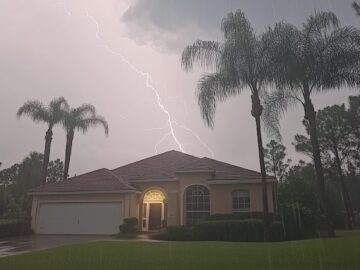
Lighting and Thunderstorm safety: A Florida Homeowner’s Guide to Preparing, Staying Safe, and Recovering After a Storm
The content provided on this page is for informational purposes only and should not be construed as legal or professional advice of any kind. Any views, opinions, and statements expressed in this content are solely those of the individual author or contributor and do not necessarily reflect the official views, opinions, or positions of Security First Insurance Company. We make no representations, warranties, or guarantees, whether express or implied, regarding the accuracy, completeness, reliability, suitability, or availability of this content. Furthermore, we do not endorse, approve or guarantee any embedded third party links or other materials. Any reliance you place on such content, links or materials is strictly at your own risk. Please see Section 7 of our Terms of Use for more information. Any copying, reproduction, or other distribution of the contents of this page is strictly prohibited.
 Spread The Word